
The joinery in a cafe or restaurant does more work than in almost any other commercial environment. A service counter is touched hundreds of times a day. A bar front is exposed to water, cleaning chemicals, and constant impact. Banquette seating carries the weight of a fully booked dining room every service. Back-of-house cabinetry has to withstand the pace and heat of a commercial kitchen environment while meeting food safety standards that have no tolerance for compromise.
Getting the joinery right in a hospitality venue is not just an aesthetic decision. It is a durability decision, a compliance decision, and a commercial decision that affects how the venue operates every day for the next five to ten years.
Northside Joinery delivers custom commercial joinery for restaurants, cafes, bars, and hospitality venues across Melbourne. This guide covers what cafe and restaurant joinery actually costs in Melbourne in 2026, what the four main joinery elements are and what drives the cost of each, what materials perform best in a high-traffic hospitality environment, and how to choose a joinery supplier who will deliver what they promise on a commercial timeline.
As a rough guide, every hospitality joinery project is different. Costs vary significantly based on the material specification, the size and complexity of each element, access constraints at the venue, and market conditions at the time of your project. The figures in this guide are indicative only and should not be used for budgeting without a site assessment from an experienced commercial joiner.
The Four Joinery Elements Every Cafe and Restaurant Needs
Hospitality joinery is not one product. It is four distinct categories of work, each with different material requirements, different compliance considerations, and different cost drivers. Understanding each one separately is the most useful way to approach a cafe or restaurant joinery budget.
Front of House: The Service Counter
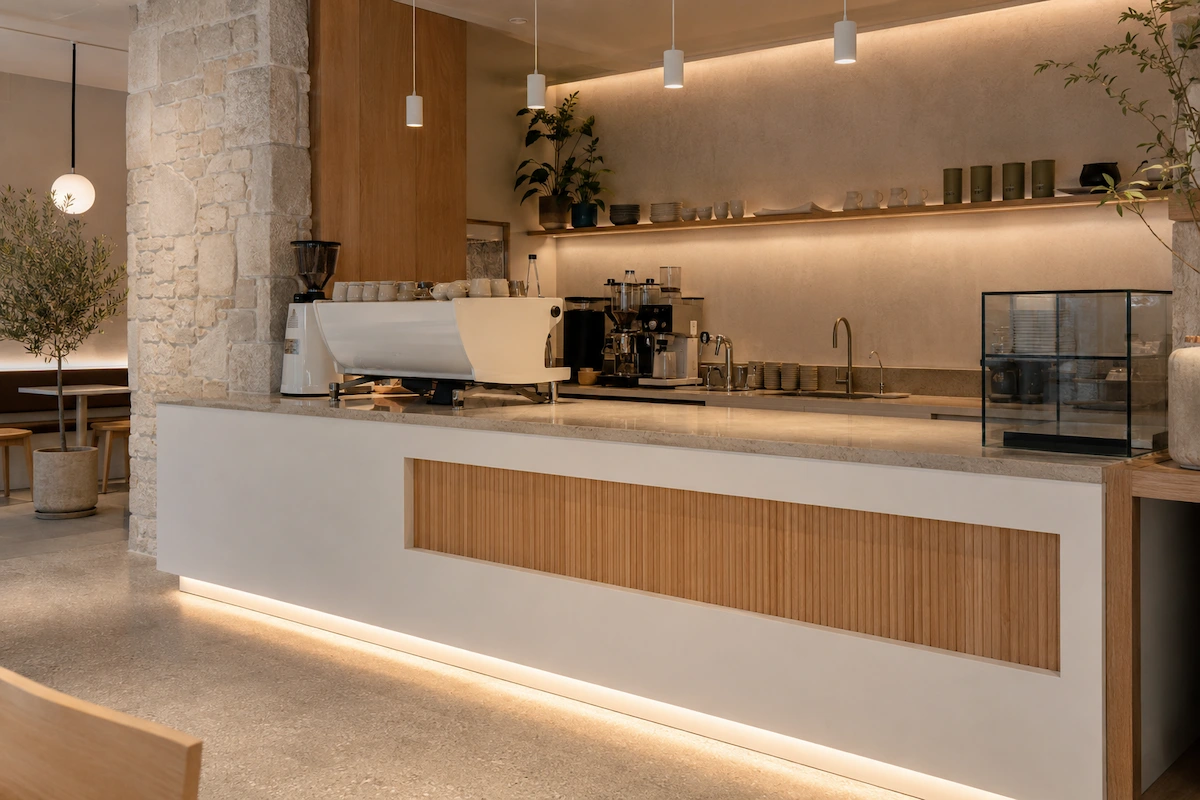
The service counter is the most important joinery element in any cafe. It is the first thing a customer sees when they walk in, the primary interaction point between staff and customers, and the element that most directly communicates the identity and quality of the venue. A poorly built service counter looks cheap immediately and shows its wear within months. A well-built custom counter defines the space and holds its look for the life of the venue.
A custom cafe service counter in Melbourne involves several integrated elements working together: the counter structure itself, the customer-facing front panel, the staff-side working surface, the integrated housing for the espresso machine and any under-counter refrigeration, the point-of-sale position with cable management and power access, and the display area for pastries, grab-and-go products, or seasonal specials.
Every one of these elements has to be designed together before manufacture begins. The espresso machine requires a specific bench height and depth. The refrigeration housing requires the correct clearance and ventilation. The POS system requires power access in the right position. Getting any of these wrong in manufacture means costly modification on site, which is why the design and specification phase for a service counter is as important as the build itself.
The front panel of the service counter is typically the most design-led element of the venue joinery. Common approaches in Melbourne hospitality in 2026 include timber veneer panels in oak and walnut tones, two-pack polyurethane painted finishes, stone cladding panels, and combinations of materials with integrated LED strip lighting. The finish choice significantly affects both the cost and the maintenance requirements of the counter over time.
Bar Fronts and Beverage Stations
A bar front in a restaurant or licensed venue faces different conditions from a cafe service counter. It is exposed to more direct water from ice, glass washing, and spills. The substrate behind the face panel is more frequently wet. The hardware is opened and closed more frequently by staff working at pace under pressure. And in a premium venue the bar front is often the architectural centrepiece of the entire space.
The material specification for a bar front reflects these demands. Northside Joinery uses moisture resistant MDF carcasses as standard for all hospitality joinery. In wet area bar applications where the substrate will be regularly exposed to water, marine-grade plywood provides additional protection behind the face material. The face material itself, whether that is timber veneer, two-pack, stone cladding, or a combination, must be selected with the specific conditions of that bar in mind.
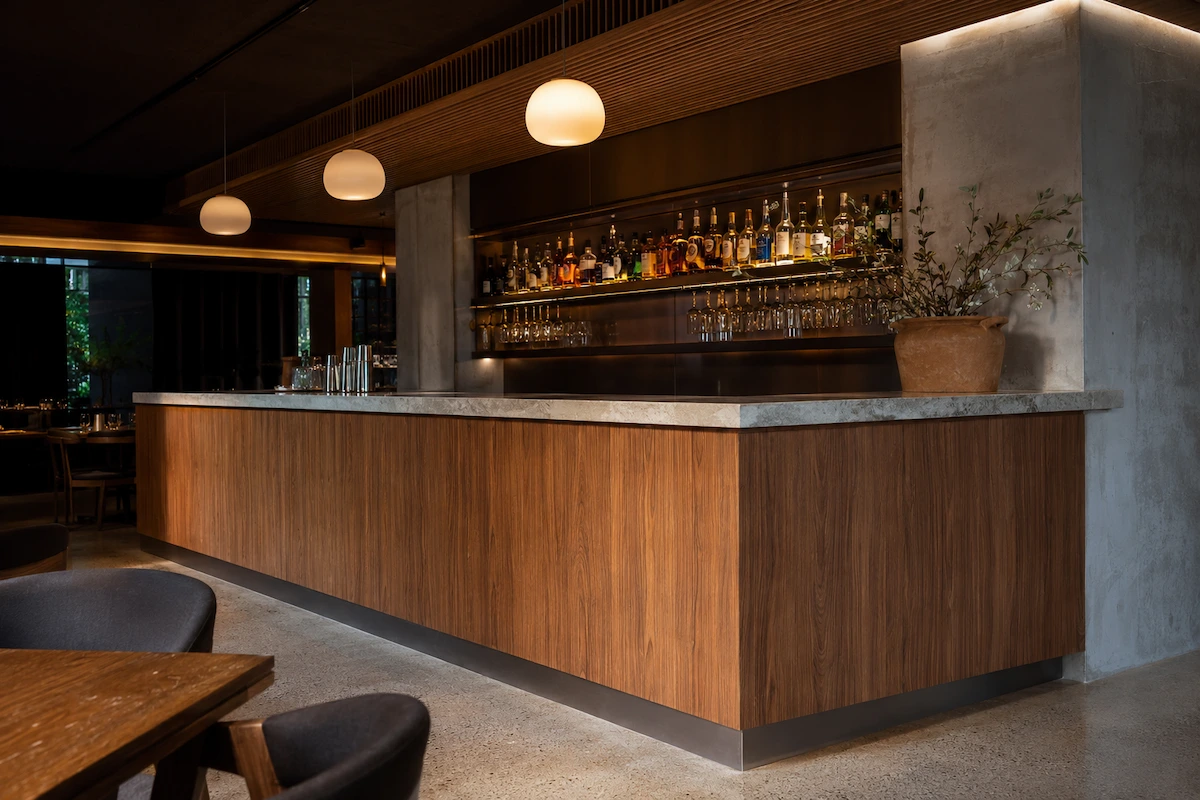
The benchtop specification for a bar or service counter has changed in Melbourne since the engineered stone ban came into effect in July 2024. Engineered quartz products that were previously the default choice for hospitality benchtops are no longer available within Australian law. The alternatives now specified are porcelain slab, Dekton and sintered stone surfaces, and natural stone. Porcelain is the most common replacement in hospitality applications, it is non-porous, resistant to staining and heat, easy to clean to food safety standards, and available in formats that suit both straight runs and curved bar configurations.
Banquette Seating and Booth Configurations
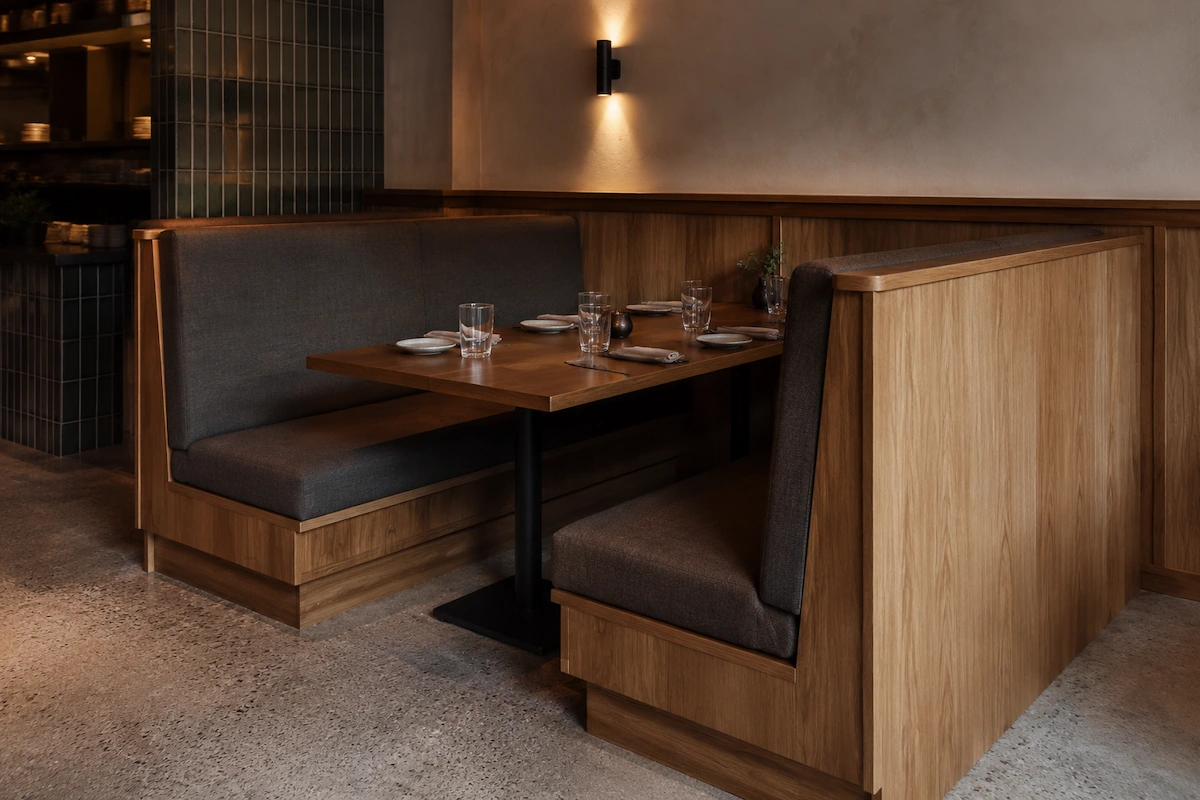
Banquette seating is the joinery element that most directly affects the capacity and revenue of a hospitality venue. A well-designed banquette configuration maximises the number of covers that fit comfortably within the floor area, creates the defined zones and intimate atmospheres that make a dining room feel considered and complete, and provides the kind of comfortable seating that keeps customers at the table longer.
The joinery component of banquette seating is the structural frame, the carcass that supports the upholstered seat and back panels. This frame is typically built from moisture resistant MDF or structural ply depending on the loading requirements and the design of the upholstery. It must be built to commercial standards, not residential furniture standards, because it will carry multiple people at full capacity every service for years without showing any movement or weakness.
The upholstery is a separate scope from the joinery frame, typically handled by a commercial upholsterer working from the dimensions of the completed joinery frame. This sequencing matters for the project programme: the joinery frames must be installed and confirmed before the upholsterer can template and fit the seat and back panels.
Back of House: Waiter Stations and Storage Cabinetry
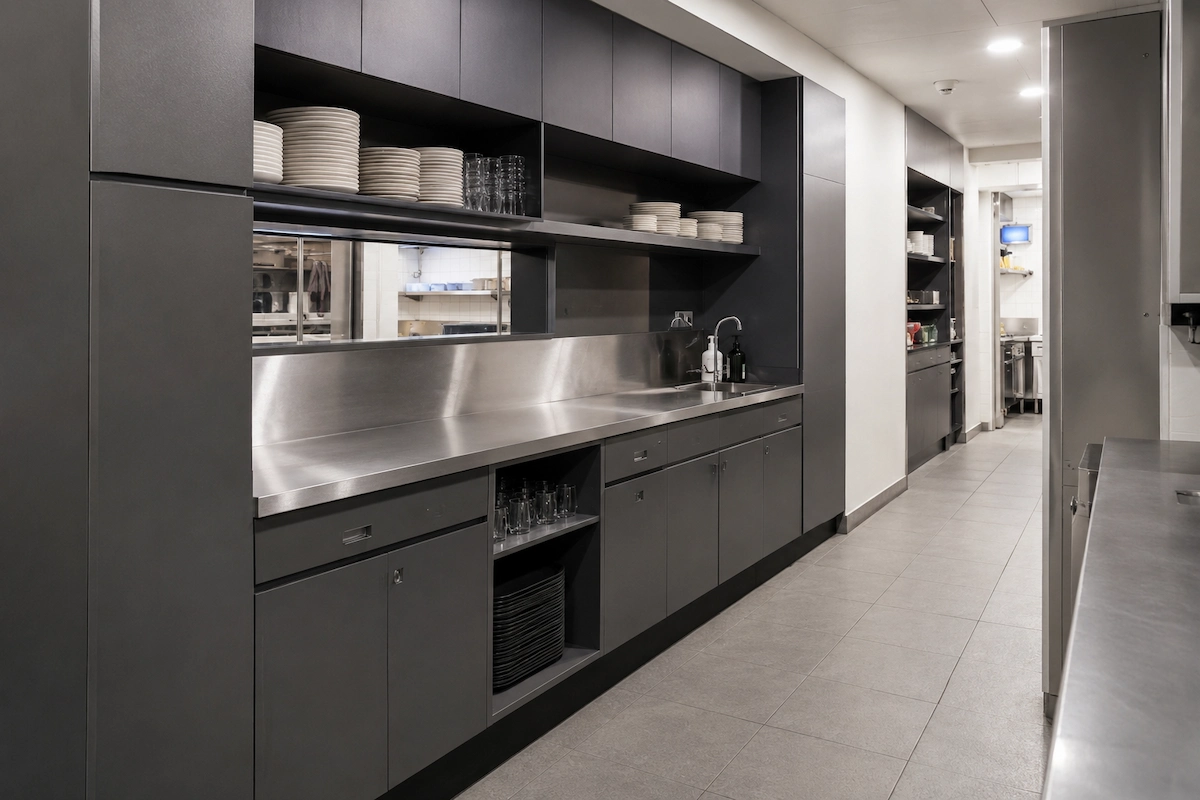
Back-of-house joinery is the most functional and least glamorous category of hospitality joinery. It is also the category where poor specification has the most direct impact on how efficiently the venue operates every service.
A waiter station that is poorly laid out adds steps and time to every service. Storage cabinetry that does not meet food safety requirements creates compliance problems at council inspection. Cabinetry that is built to residential standards rather than commercial standards shows its wear within a year of opening and becomes a maintenance problem before the venue has had time to establish itself.
Back-of-house joinery in Melbourne hospitality venues must meet the food safety and hygiene requirements of the Food Standards Australia New Zealand (FSANZ) framework as adopted by the relevant Victorian council. The practical joinery requirements this creates include: non-porous surface materials with no exposed joins or crevices where bacteria can accumulate, smooth and cleanable surfaces on all food contact and food-adjacent areas, and substrate materials that resist moisture and can withstand the regular cleaning with commercial-grade chemicals that a hospitality kitchen requires.
High-pressure laminate is the standard specification for back-of-house cabinetry in Melbourne hospitality. It is more durable than two-pack polyurethane in a high-impact environment, resistant to the cleaning chemicals used in commercial kitchens, and significantly less expensive per linear metre than premium front-of-house finishes, which is the right trade-off for an area customers never see.
What Restaurant and Cafe Joinery Costs in Melbourne 2026
The figures below are rough guides based on current Melbourne market conditions and Northside Joinery's experience delivering commercial joinery for hospitality venues across Melbourne. Every project is different. Material costs and labour rates fluctuate and these figures may not reflect what your project costs at the time you proceed. Do not use these figures for budgeting without a site assessment and quote for your specific venue.
Custom Cafe Service Counter
A custom cafe service counter of 2 to 4 linear metres with two-pack polyurethane or timber veneer front panel, integrated espresso machine housing, under-counter refrigeration housing, POS position with cable management, and porcelain slab benchtop.
Broad indicative range: $3,000 to $8,000 and above for the joinery component, depending on length, material specification, and integrated features. Benchtop fabrication and installation is a separate cost on top of the joinery figure.
What moves this higher: longer counter run, curved counter configuration, feature lighting integration, premium timber veneer or stone cladding front panel, additional display elements or pastry case housing.
Restaurant Bar Front
A custom bar front of 3 to 6 linear metres with moisture resistant carcass, marine-grade substrate in wet area sections, premium face material in timber veneer or two-pack, integrated refrigeration housing, and porcelain slab benchtop.
Broad indicative range: $5,000 to $15,000 and above for the joinery component depending on length, material specification, and complexity of the design. Premium architectural bars with curved profiles, feature lighting, and multi-material facades sit at the upper end and above.
Banquette Seating Frames
Custom banquette frames in moisture resistant MDF or structural ply, built to commercial loading standards, ready for upholstery by a commercial upholsterer.
Broad indicative range: $800 to $2,000 per seat position depending on the configuration, height, and structural complexity of the design. Linear banquettes cost less per seat than corner booth configurations.
Back of House Cabinetry and Waiter Stations
Custom high-pressure laminate cabinetry for back-of-house storage, waiter stations, and pass-through positions. Built to FSANZ food safety surface requirements.
Broad indicative range: $900 to $1,800 per linear metre depending on the configuration, the number of drawers and internal fittings, and the complexity of the installation.
Important: these figures are rough guides only. Restaurant and cafe joinery costs in Melbourne vary significantly depending on the material specification, the size and complexity of each element, CBD and inner-city access constraints, after-hours installation requirements, and market conditions at the time your project is priced. Two venues of the same size and style can produce joinery costs that differ substantially based on these variables. Do not use these figures for budgeting without a site assessment from an experienced commercial joiner. Every Northside Joinery project is assessed individually by James Taliana before any pricing is provided.
Planning a cafe or restaurant fitout in Melbourne? Northside Joinery delivers custom hospitality joinery from its in-house Melbourne workshop. 8-week delivery guarantee or we pay you $1,000. Book a site assessment with James before you commit to anything.
Materials That Perform in a Hospitality Environment
The material choices that work in a residential kitchen or bathroom are not always the right choices for a commercial hospitality environment. The frequency of use, the exposure to water and cleaning chemicals, and the physical demands of a high-volume venue require materials specified specifically for commercial applications.
Moisture resistant MDF carcasses are the standard for all Northside Joinery hospitality work. In a venue where cleaning is constant and spills are inevitable, particle board carcasses absorb moisture, swell, and fail. Moisture resistant MDF holds its integrity in the conditions a hospitality venue creates.
Two-pack polyurethane is the most durable painted finish available for front-of-house joinery. It is harder than standard paint, more resistant to impact and marking, and cleanable with the commercial cleaning products used in hospitality environments. For a service counter that is wiped down dozens of times a day, two-pack significantly outlasts standard painted finishes.
Timber veneer in commercial-grade specification with appropriate sealing is a premium front-of-house option that provides warmth and character without the maintenance demands of solid timber. Oak and walnut veneer are the dominant choices in Melbourne hospitality in 2026.
High-pressure laminate is the right specification for back-of-house applications. More impact resistant than two-pack in a high-traffic environment, available in a wide range of food-safe finishes, and significantly more cost-effective than premium front-of-house materials for areas that customers never see.
Porcelain slab benchtops are the standard specification for service counter and bar benchtops since the engineered stone ban. Non-porous, heat resistant, stain resistant, and cleanable to food safety standards. Available in large format slabs that suit long counter runs with minimal joins.
Blum hardware is the commercial standard for all drawer runners and hinges in Northside Joinery hospitality work. Rated for high-frequency commercial use, Blum hardware maintains smooth operation under the daily demands of a hospitality kitchen and service environment that would wear standard residential hardware within months.
How to Choose a Hospitality Joinery Supplier in Melbourne
Look for in-house manufacturing. A joinery supplier who builds in their own workshop controls quality and timeline. A supplier who outsources manufacture to a third party cannot give you the same guarantees on either. When a delivery date is critical to your opening schedule, and in a commercial fitout it always is, in-house manufacture is the only reliable basis for a delivery commitment. Northside Joinery manufactures all joinery in its own Melbourne workshop. The 8-week delivery guarantee is only possible because the production schedule is controlled in-house.
Ask specifically about commercial hospitality experience. A residential cabinet maker and a commercial hospitality joiner are different specialists. The material specifications, the compliance requirements, the installation pace, and the ability to work alongside other trades on a commercial programme are all different. Ask for examples of hospitality joinery the supplier has delivered, the venues they worked in, and the joinery elements they built.
Understand the full scope before committing. A joinery quote that does not include a clear inclusions and exclusions schedule is not a complete quote. Confirm whether the benchtop is included or quoted separately. Confirm whether installation is included. Confirm what happens if a dimension changes between quote and manufacture. A supplier who cannot answer these questions clearly before you commit is a risk in a commercial fitout where every variation has a cost and a time impact.
Confirm the delivery guarantee in writing. In a commercial fitout, joinery delays flow through to every other trade and ultimately to your opening date. Every week of delay in a venue with a signed lease costs real money. A supplier who will not commit to a delivery date in writing does not have confidence in their own timeline. Northside Joinery's 8-week delivery guarantee is in writing and backed by a $1,000 payment if it is not met.
Get a site assessment before finalising any design. An accurate hospitality joinery quote cannot be produced from a floor plan alone. The actual dimensions, the service infrastructure positions, the ceiling heights, the access constraints, and the relationship between the joinery and the other trades all affect the scope and the cost. A site assessment before design is finalised protects the budget and the timeline.
Ready to discuss your venue joinery? James Taliana has been delivering custom commercial joinery for Melbourne hospitality venues for 16 years. Contact Northside Joinery today for an honest conversation about your project before you commit to anything. No obligation. Just clarity.
Frequently Asked Questions
How much does cafe joinery cost in Melbourne?
As a rough guide, cafe and restaurant joinery in Melbourne in 2026 ranges from approximately $900 to $2,500 per linear metre for custom-built cabinetry and joinery elements, depending on the material specification and complexity of the work. A custom cafe service counter typically costs $3,000 to $8,000 or more depending on the length, finish, and integrated features such as refrigeration housing and LED lighting. Overall cafe and restaurant fitouts where joinery represents a significant portion of the budget range from $1,500 to $3,400 per square metre. These figures are indicative only and vary significantly based on materials, complexity, access constraints, and market conditions at the time of your project. A site assessment is required for accurate pricing.
What joinery does a cafe or restaurant need?
A cafe or restaurant typically requires joinery across four main areas. Front of house covers the service counter or bar front, the primary customer-facing element that defines the visual identity of the venue. Seating joinery includes banquette frames and booth configurations where customers sit. Back of house covers waiter stations, storage cabinetry, and pass-through joinery between the kitchen and floor. Kitchen joinery includes cabinetry and storage designed to meet food safety and hygiene requirements. The joinery scope and budget vary significantly depending on the size and style of the venue.
What materials are used for hospitality joinery in Melbourne?
The most common materials for hospitality joinery in Melbourne in 2026 are moisture resistant MDF carcasses with two-pack polyurethane or timber veneer finishes for front of house elements, and high-pressure laminate finishes for back of house and storage cabinetry that requires maximum durability and ease of cleaning. Bar fronts in premium venues use marine-grade substrates in wet area applications. Stone and porcelain benchtops are the standard specification for service counters following the engineered stone ban in July 2024. Blum hardware is the commercial standard for drawer runners and hinges due to its durability under the high-frequency use of a commercial hospitality environment.
How long does cafe joinery take to build and install in Melbourne?
As a general guide, custom cafe and restaurant joinery from Northside Joinery takes approximately 6 to 8 weeks from confirmed order to installation. This covers design finalisation, material procurement, and in-house manufacture. On-site installation for a standard cafe fitout typically takes 3 to 7 days depending on the scope and complexity of the work. Melbourne CBD and inner-city venues with restricted loading dock access or after-hours installation requirements may add time to the installation schedule. The Northside 8-week delivery guarantee applies to all projects.
How do I choose a hospitality joinery supplier in Melbourne?
When choosing a hospitality joinery supplier in Melbourne, look for three things above all others. First, in-house manufacturing: a supplier who builds in their own workshop controls quality and timeline. A supplier who outsources manufacture cannot guarantee either. Second, commercial hospitality experience: residential cabinet makers and commercial hospitality joiners work to different standards of durability, compliance, and installation speed. Ask specifically about their hospitality project history. Third, clear scope and timeline commitment: a joinery supplier who cannot give you a clear delivery timeline and a written scope before you commit is a risk in a commercial fitout where every day of delay costs trading revenue.